
Foundation or Higher GCSE Maths? A Guide for Parents
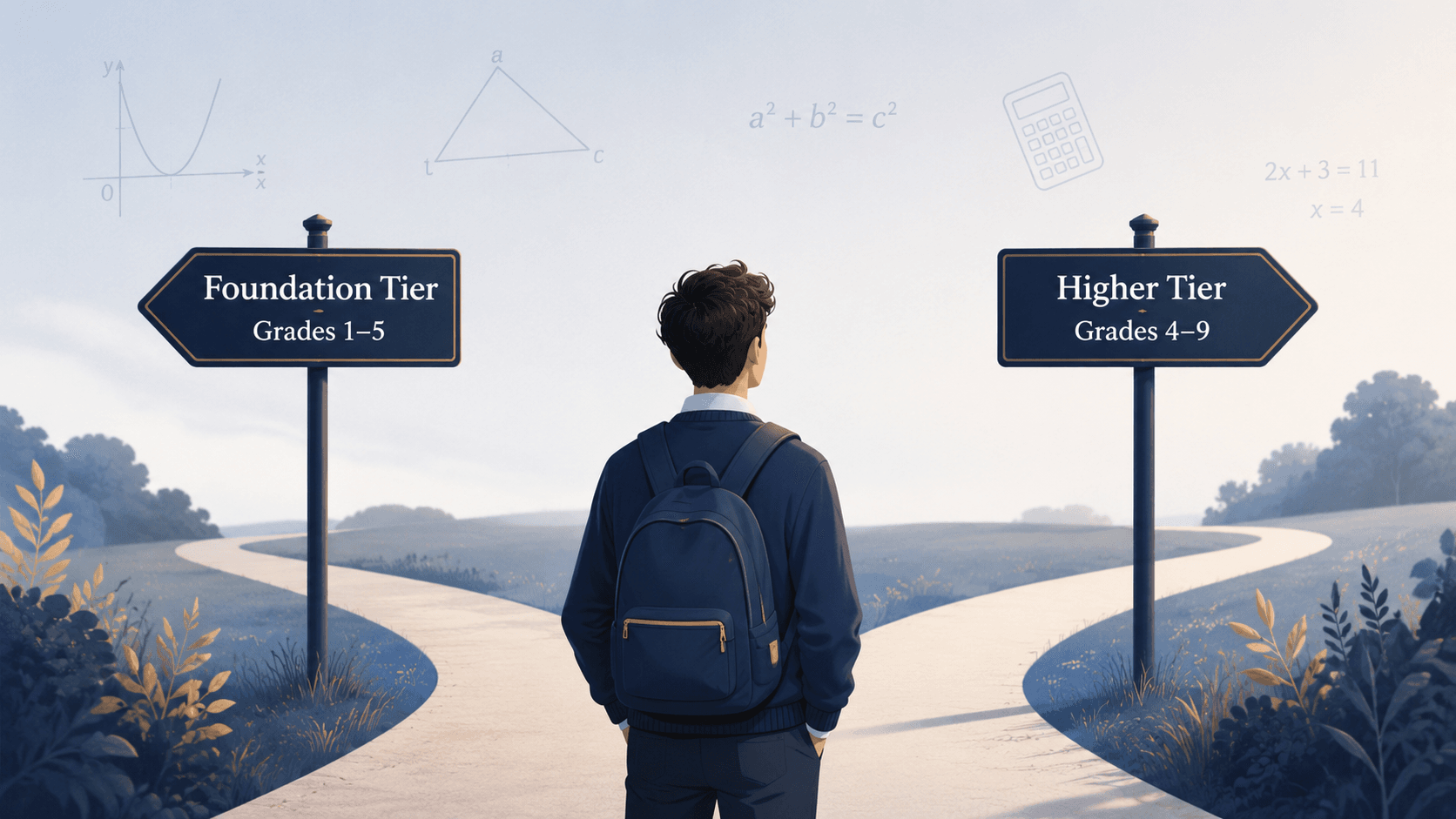
Higher is not automatically the better paper. It is the harder paper. The right tier depends on the grade your child needs, how securely they can access each paper and what the evidence shows across more than one assessment.
What parents need to know first
Best when a secure grade 4 or 5 is the priority.
Required if your child needs grade 6 or above.
If your child needs a grade 6 or above, they must sit Higher. If they need a 4 or 5, either tier may be appropriate. The right question is not “which tier sounds better?” but “which paper gives my child the strongest realistic chance of achieving the grade they actually need?”
How teachers should make the decision
A sensible tier decision should not rest on one mock result. In school, I look at the pattern across classwork, assessments and mock papers. I also look beyond the percentage on the front.
How much of the paper is accessible?
The final Higher questions are designed to stretch the strongest students. What matters is whether your child can collect marks through the early and middle sections.
Where are the marks being lost?
Missing knowledge, poor timing, weak method, careless slips and exam nerves all need different solutions.
Are the gaps specific or widespread?
One weak topic may be fixable. Gaps across number, ratio and algebra point to a deeper issue.
What grade does the student actually need?
This can change the decision completely. A student who needs grade 6 must keep the Higher route open.
No single percentage settles the tier on its own. Grade boundaries change, schools use different papers and students can underperform on one difficult day. A raw mark is useful evidence, but it is not a verdict.
Which way does the evidence point?
Foundation may be the stronger choice when
- Your child only needs grade 4 or 5.
- Foundation results are consistently more secure.
- Large parts of Higher papers are left blank.
- Gaps affect core number, ratio and algebra skills.
- Higher preparation is taking too much time from other subjects.
Higher may remain appropriate when
- Grade 6 or above is needed for the next step.
- Your child is around a secure grade 5 and improving.
- Core skills are reasonably secure.
- Weaknesses are specific and fixable.
- Your child can follow a focused revision plan.
Two students, two correct decisions
Similar evidence can lead to different tiers when the required grade is different.

Foundation was the strategic choice
Adam kept landing on a high grade 4 in Higher mocks. On Foundation papers, he was achieving a comfortable grade 5. Two months before the exams, the key question was simple: what grade did he actually need?
He needed grade 5 for his college course. A Higher grade 5 was possible, but it was not secure. Foundation gave him a stronger route to the grade required and allowed him to protect revision time for his other GCSEs.
He sat Foundation and achieved grade 5.
Higher remained necessary
Zoe’s Foundation assessments were stronger than her Higher ones, but she needed grade 6 for her college place. Moving to Foundation would have made that grade impossible.
Her lower Higher result had a clear cause: weak preparation rather than a lack of ability. She agreed to a structured revision plan, targeted support and extra intervention, knowing that staying on Higher still carried real risk.
She stayed on Higher and achieved grade 6.Two students, similar evidence, opposite decisions — and both decisions were right.
Do not change tier before identifying the cause
A low mock can come from different problems. The next step should match the reason the marks were lost.
Five questions to ask the school
- What evidence is the recommendation based on? One mock, or a pattern across several assessments?
- How does my child perform on each tier? If they have sat both, ask for a direct comparison.
- Which topics are costing the most marks? Ask for more than a total percentage.
- What grade does my child need for the next step? Check the actual college or sixth-form requirement.
- When will the decision be reviewed? Ask what must improve, by when, and which assessment will be used.
Foundation and Higher FAQs
Has my child been given up on if they are moved to Foundation?
Usually not. The school may believe Foundation gives your child the strongest realistic chance of securing the grade they need. Ask for the evidence and the plan behind the decision.
Is a grade 5 on Foundation worth less than a grade 5 on Higher?
No. A grade 5 is recorded as a grade 5.
Can the tier be changed later?
Often yes, before final exam entries are confirmed. Ask the school for its deadline and review process.
Does Higher look better to colleges?
Colleges usually focus on the grade achieved. Higher matters when a course requires grade 6 or above.
What happens if a student falls below grade 4 on Higher?
Higher includes a narrow allowed grade 3. Results below that are unclassified.

Qualified secondary maths teacher and GCSE examiner with more than 10 years of classroom experience, supporting KS3 and GCSE students with gaps, confidence, tier decisions and exam technique.
Not sure which tier is right for your child?
Talk through the evidence, the grade required and the most useful next step. If tuition is not the right answer, I will still suggest what I would do next.